PROTOCOL ACTIVE.
INCOMING CALL: UNIT 1379.
ENCRYPTION: LEVEL 4.
FIRST THE LIGHT. THEN THE COLD. NOW THE MONEY.
BRIEFING FOR 19:00 · 6 NOVEMBER
1. Paraguay. On 3 November the central bank took control of the digital bank Ueno. About three million people kept their money there, roughly six in ten adults in the country. In the morning they could neither withdraw nor transfer: the app would not let them in. Since 5 November money is being returned through other banks in groups, first to those with up to 10 million guaraníes; no date for the rest. AP, 03.11; La Nación, 05.11; EFE, 06.11.
2. The grounds. The bank's own capital turned out to be less than half of what the law requires. Under a 2003 law, the central bank must then start winding it down. Bloomberg Línea, 03.11; Law No. 2334/03, articles 13 and 14.
3. Power. On 5 November President Santiago Peña announced his resignation. The resignation was not taken up; deputies unanimously launched an impeachment trial. Today the Senate hears his defence. Infobae, La Nación, 05..06.11.
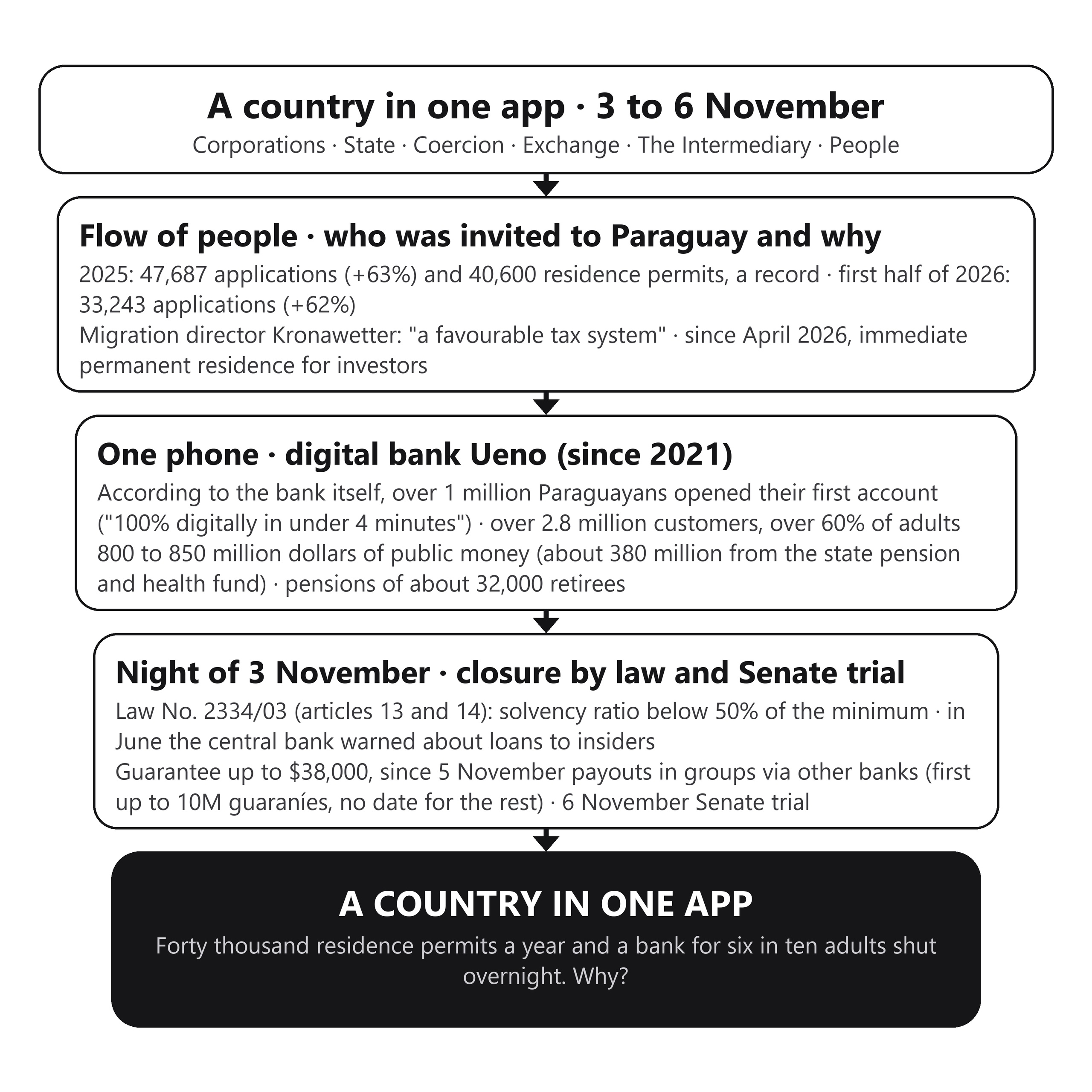
4. People. In 2025 Paraguay granted foreigners 40,600 residence permits, a record. In the first half of 2026 applications were up 62% on a year earlier. La Nación, 27.01; Última Hora, 25.07.
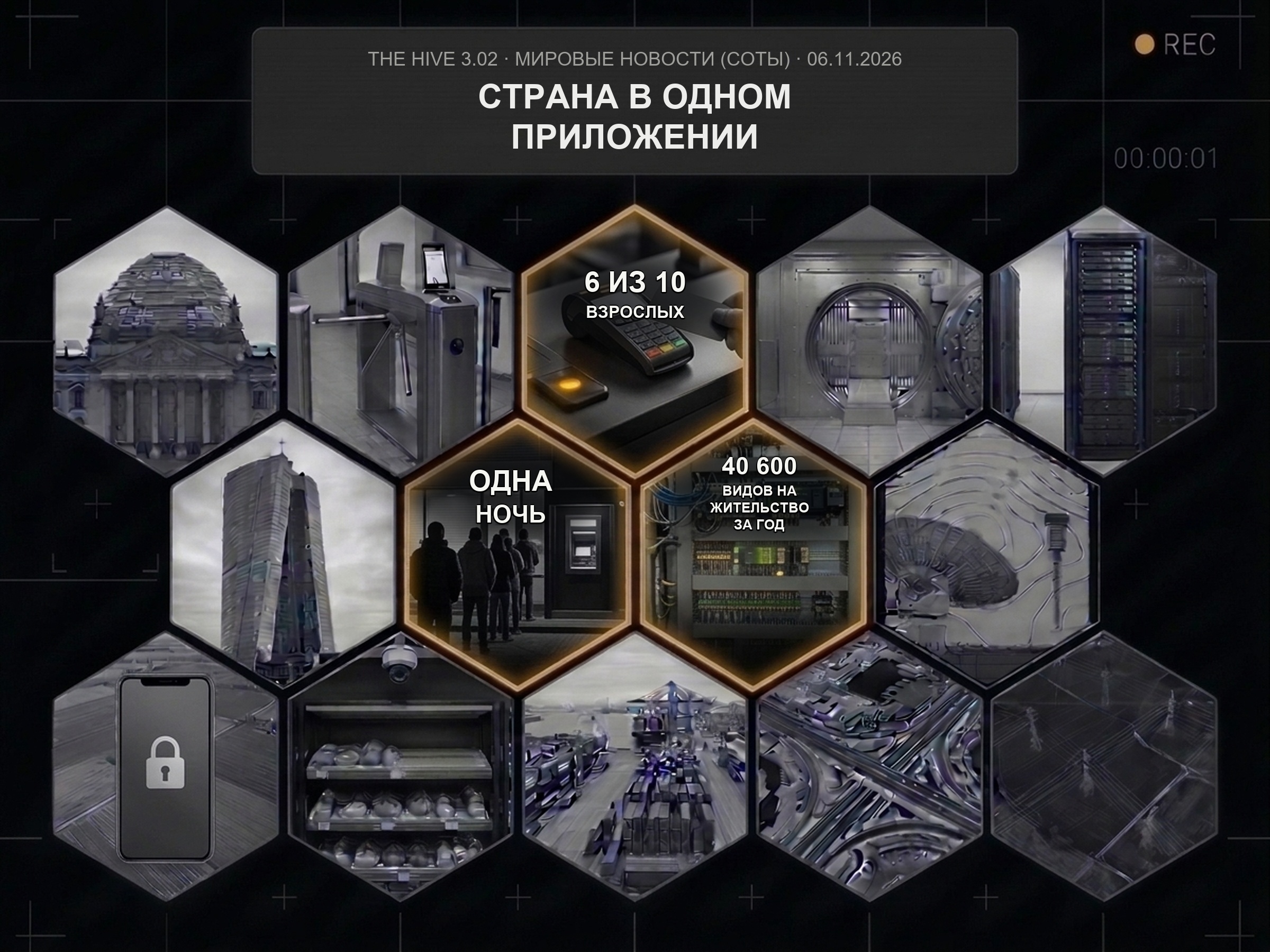
World News (The Hive) · 6 November, briefing from 3 to 6 November. In recent years people have moved to Paraguay by the tens of thousands: for low taxes, fast residence permits, a quiet life. On social media it was shown as a place to move to. On 3 November, in that same country, a bank holding the money of six in ten adults was switched off overnight. The law under which it was closed is short and clear. The questions don't end there.
Loud
Table 5 · Corporations · 28 March and 3 November · Ueno, AP.
They say: Ueno opened in 2021 as a bank in a phone. In March 2026 the bank itself wrote that more than a million Paraguayans who had never had an account opened their first one with Ueno; it has more than 2.8 million customers, over 60% of the country's adults; an account opens "100% digitally in under 4 minutes". On 3 November the central bank took control of the bank. Customers could not withdraw or transfer money, the app locked them out, and people gathered outside closed branches across the country. Ueno, 28.03 · AP, 03.11
Decoding 1379: a million people opened a bank account for the first time in their lives, on a phone, in four minutes. It was all shut in one night. Why?
Open: four minutes. Shut: one night.
Table 6 · State · 3 November · Law No. 2334/03, Bloomberg Línea, AP.
They say: under Paraguay's Law No. 2334 of 2003, the central bank starts the resolution of a bank whose "solvency ratio falls below fifty percent (50%) of the minimum required by law" (article 13). Once it learns of this, the central bank's board "shall order the start of the resolution procedure" (article 14): it has no choice. According to Bloomberg Línea, Ueno's ratio fell below that line after its financial statements were adjusted. According to AP, back in June the central bank warned Ueno that it was lending too much to companies tied to its owners. Law No. 2334/03 · Bloomberg Línea, 03.11 · AP, 03.11
In plain words: a bank must keep a cushion of its own money in case some loans are not repaid. When Ueno's statements were recalculated, the cushion was less than half the norm. In that case the law gives the central bank no choice: it must start closing the bank.
Decoding 1379: the central bank told the bank about lending to its own in June. It closed the bank in November. Why?
Warned in June. Closed in November.
Coercion

Table 6 · State · Law and norm · Law No. 2334/03, AP.
They say: the same law guarantees deposits up to 75 minimum monthly wages per person per bank: 228.3 million guaraníes, about 38,000 dollars; by a preliminary estimate that covers about 97% of Ueno's depositors. On 4 November a new law allowed part of it to be paid early, as an advance of up to 40 minimum wages, about 121.8 million guaraníes, minus debts to the bank; the money goes to an account at another bank, and one is opened automatically for those without. On 5 November the central bank began paying the first group: those with up to 10 million guaraníes (about 1,700 dollars), no debts to Ueno and an account at another bank; they get everything. The central bank promised to announce dates for the other groups later. People linked to the bank get no guarantee. On the first day the central bank's lookup pages buckled under demand. Law No. 2334/03, article 1 · AP, 03.11 · ABC Color, 04.11 · La Nación, 05.11 · EFE via Infobae, 06.11 · Rio Times, 06.11
Decoding 1379: people are getting their own money back in groups, through other banks. First those who had the least. Why?
First those who had the least.
Exchange

Table 6 · State · Money and credit · AP, Bloomberg Línea.
They say: Ueno held 800 to 850 million dollars of public money, about 380 million of it invested by the state pension and health fund. Government deposits at the bank rose sharply after Santiago Peña became president in 2023; at the end of June they were 29% of all its deposits. About 32,000 retirees collected their pensions through Ueno; the fund says payments continue as usual and the pensioners are being moved to another bank. AP, 03.11 · Bloomberg Línea, 03.11
Decoding 1379: public money and pensions went into one bank for three years. In June the bank was warned. In November the pensions were still there. Why?
The pensions sat in a phone.
The Intermediary

Table 6 · State · Power and oversight · AP, Reuters, Bloomberg Línea.
They say: Carlos Carvallo, according to Ueno itself, led the bank until August 2023. Then President Peña put him in charge of the central bank. The central bank says Carvallo recused himself from all decisions on Ueno and there was no conflict of interest; on 3 November Carvallo resigned. Peña himself, according to AP and Reuters, was a business partner of the group that owns Ueno until March 2025; Ueno says Peña was never a shareholder or investor in the bank. On the day of the closure Peña wrote on X: "This is an isolated case of a single entity, not of the national financial system." AP, 03.11 · Reuters, 22.10 · Bloomberg Línea, 03.11
Decoding 1379: the man who ran the bank later supervised every bank in the country. The president called the closure an isolated case. Why?
Ran the bank. Then supervised the banks.
People
Table 6 · State · Migration · National Migration Directorate, BBC News Brasil.
They say: in 2025 foreigners filed 47,687 residence applications in Paraguay, 63% more than a year earlier, and were granted 40,600. Brazilians led (23,526), then Argentines (4,366), Germans (1,652), Spaniards (1,023), Dutch (772), Americans (736), French (472). The head of the migration service, Jorge Kronawetter, named "a favourable tax system" first among the reasons. In the first half of 2026 there were 33,243 applications, up 62%; the service called it "a historic demand for residence in Paraguay". In April the government announced permanent residence straight away, without a temporary permit, for those investing in tourism, real estate and finance. According to BBC News Brasil, this spring hundreds of Brazilians camped overnight outside a migration centre in Ciudad del Este to get an appointment; many decided to move after videos by influencers. Retired teacher Zena Cheraze from Rio: "We on the right feel like the most oppressed people. We have no freedom." La Nación, 27.01 · Última Hora, 25.07 · MercoPress via BBC News Brasil, 16.04
Decoding 1379: people left their countries for freedom and low taxes. In the new country, the money of six in ten adults sat in one app. Why?
Left for freedom. Arrived in a country of one app.
Condition
In recent years people moved to Paraguay for a quiet life and low taxes: forty thousand residence permits in 2025, a record. On 3 November a bank holding the money of six in ten adults was closed there overnight. The legal ground is simple: the bank's own capital was below half the norm. The central bank had warned about lending to insiders back in June. The president, who until March 2025 was a business partner of the bank's owners, announced his resignation; it was not taken up, and today he stands trial. All day today I am putting only originals on the table: who invited people to Paraguay and with what, how a country's money ended up in one phone, where this was shown before, and what was said about it from the podium. Why?