PROTOCOL ACTIVE.
INCOMING CALL: UNIT 1379.
ENCRYPTION: LEVEL 4.
YOU ARE KNOWN
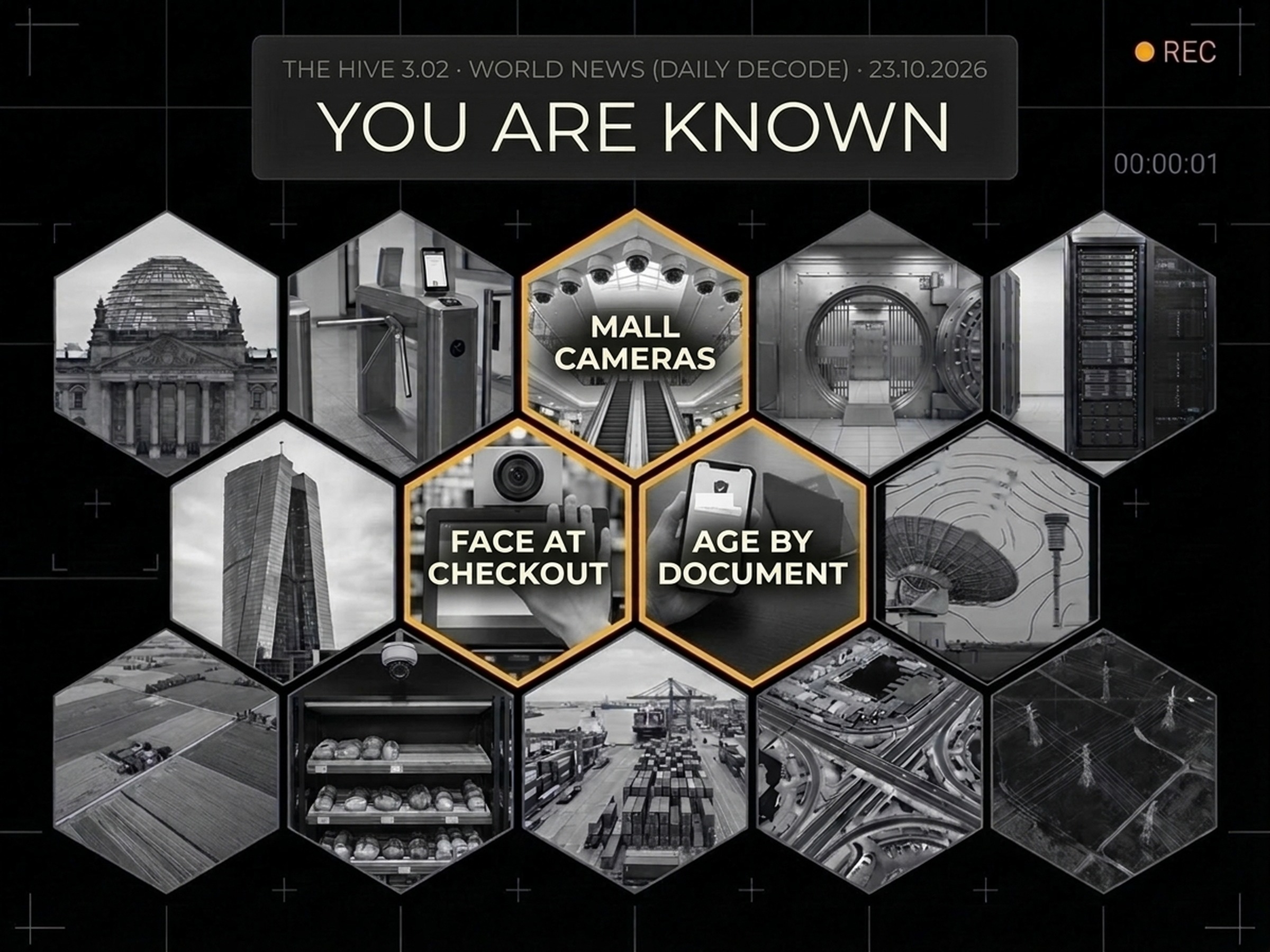
World News (Daily Decode) · 23 October, from the digest of 16 to 20. In Hong Kong, private mall cameras are being wired into the police network: a target of 60,000 cameras by 2028. In the United States a court let a state demand a document at the door of social media: fail to prove your age and you are a child. The checkout is learning to recognise the shopper by face and palm, and "the anonymous cardholder becomes a known customer." In the emergency room a language model reads the chart and moves down the queue anyone with one extra line in the record. Four stories, one line: you are known. Yesterday a pass was needed everywhere. Today nobody asks for it: you are known by face, by record and by age.
LOUD
Hong Kong · SCMP.
They say: 18 October, SCMP: Secretary for Security Chris Tang said the police are in talks to connect the cameras of private shopping centres to the city's expanding smart surveillance network; the city's target of 60,000 cameras by 2028 is "set to expand even further"; round-the-clock streaming will depend on the crime risk of the place; "If the system requires it, I will connect and retrieve the data"; the argument: "in some places without CCTV, members of the public do not want to visit because they are dangerous." SCMP
Decoding 1379: the mall installed the mall's cameras. From now on it is the police who will be watching through them. Why: building your own network is slow and expensive, and somebody else's already hangs on every floor. Nobody installs it. They connect to it.
The mall hung the camera. It is not the mall that watches.
THE TURN
London, 1791 · a building from which everyone is seen.
They say: Britannica: in 1791 Jeremy Bentham published the plans of the panopticon, a prison in the form of a circular, glass-roofed, tank-like structure, with cells along the outer wall facing a central rotunda from which the guards see every inmate. Britannica
Decoding 1379: back then one building, one rotunda, one prison. Why now: the rotunda was taken out of the prison into the city and wired to every camera already hanging there. No building has to be built. It assembles itself out of other people's walls.
Bentham built a rotunda. Now the rotunda is a network.
Coercion
Identification & biometrics · SCMP.
They say: same article, 18 October: the smart surveillance network keeps growing, and the target of 60,000 cameras by 2028 is, in Tang's words, set to expand even further; which centres connect first is not named; live streaming goes where the risk is higher. SCMP
Decoding 1379: sixty thousand is not a number of cameras. It is a number of places where you can be seen. Why: the more points, the shorter the gap between them, and in that gap lived what used to be called "just walking through".
Between the cameras there is less and less street.
Meaning
Screen & narrative · ID Tech.
They say: 16 October, ID Tech: on 15 October a panel of the US Court of Appeals for the Eleventh Circuit vacated the injunction that had blocked Georgia's SB 351; social media services must make "commercially reasonable efforts" to verify every user's age; users who cannot be verified are treated as minors; parents must consent before children under 16 join; Attorney General Chris Carr called the decision "a major win for Georgia families"; NetChoice is "evaluating its next legal steps." ID Tech
Decoding 1379: could not prove your age, so you are a child. Why: the rule is written so that everyone shows a document, not only children. An adult without one loses the rights of an adult.
No document shown, you count as a child. At any age.
Exchange
Money & credit · Biometric Update.
They say: 16 October, Biometric Update: PAX is building Wink's face and palm recognition into its checkout terminals; the customer opts in through the merchant's website or app, at the counter shows a face or a raised palm, the system performs liveness detection, finds the profile and the payment token; Wink's Matt Marino: "the anonymous cardholder becomes a known customer"; merchants get "faster lanes and greater loyalty." Biometric Update
Decoding 1379: the card paid and kept quiet about who you are. The palm pays and tells. Why: a "known customer" is a customer whose purchases lie in one record with his face. A faster lane, a longer memory.
The card did not know who you were. The palm knows.
Life Support
Food & medicine · UT Southwestern.
They say: 20 October, UT Southwestern, a study in npj Digital Medicine: three open-source language models ranked the emergency department patients of two hospitals for care; records of frequent ED visits and of psychiatric emergencies made the models push down the queue patients who later deteriorated; in some instances "nearly 10% of patients were incorrectly downgraded"; first author Philip Jarrett: "stigmatizing language can steer clinicians away from the patients who need care the most." UT Southwestern
Decoding 1379: the queue for help is built not by pain but by the record. Why: the model reads not the person but his history, and the line "frequent visits" weighs more than the fact that he is in trouble right now.
What moves you in the queue is not pain. A line in the chart.
The Intermediary
AI & algorithms · UT Southwestern.
They say: same release, 20 October: before the stigmatizing details were added, all three models found high-risk patients markedly better than chance; senior author Andrew Jamieson: "a single added detail sometimes shifted a model's priority away from the patient who later deteriorated"; the bias differs from model to model, so the authors demand that every tool be tested against real patient outcomes before use. UT Southwestern
Decoding 1379: the intermediary between you and the doctor does not see you. It sees text. Why: text is convenient for a machine to read, a person is not. And the more is written about you, the less of you is left in that queue.
The model reads about you. Not you.
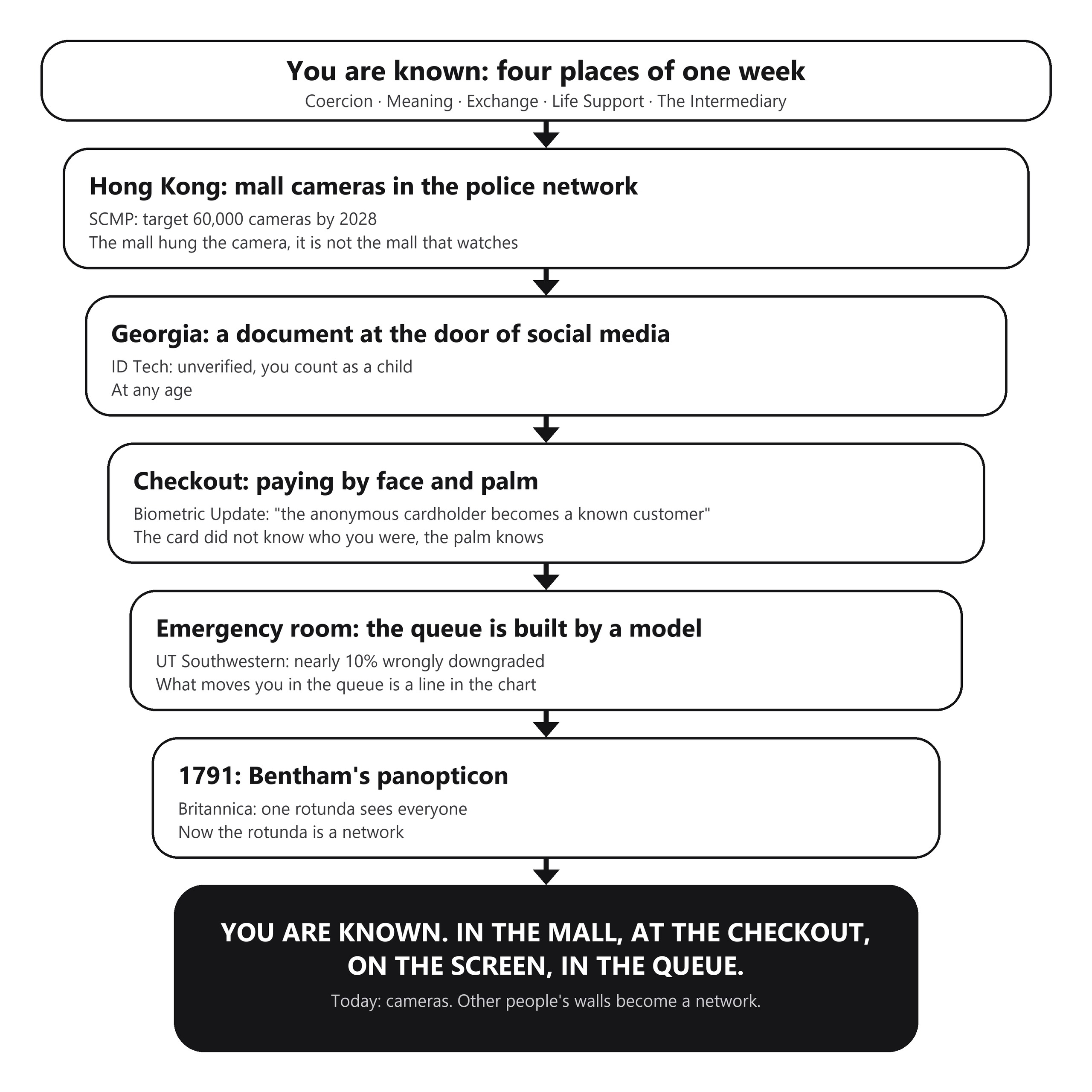
Mall, checkout, screen, queue
One week, one line. Mall cameras get wired into the police network so that you are seen wherever you go. The checkout learns your face so that the purchase lands in one record with you. The screen asks for a document so that anyone without one becomes a child. The queue in the emergency room is built by a model from a line in the chart. Yesterday they demanded a pass. Today it is no longer needed: you are known. Today: cameras.